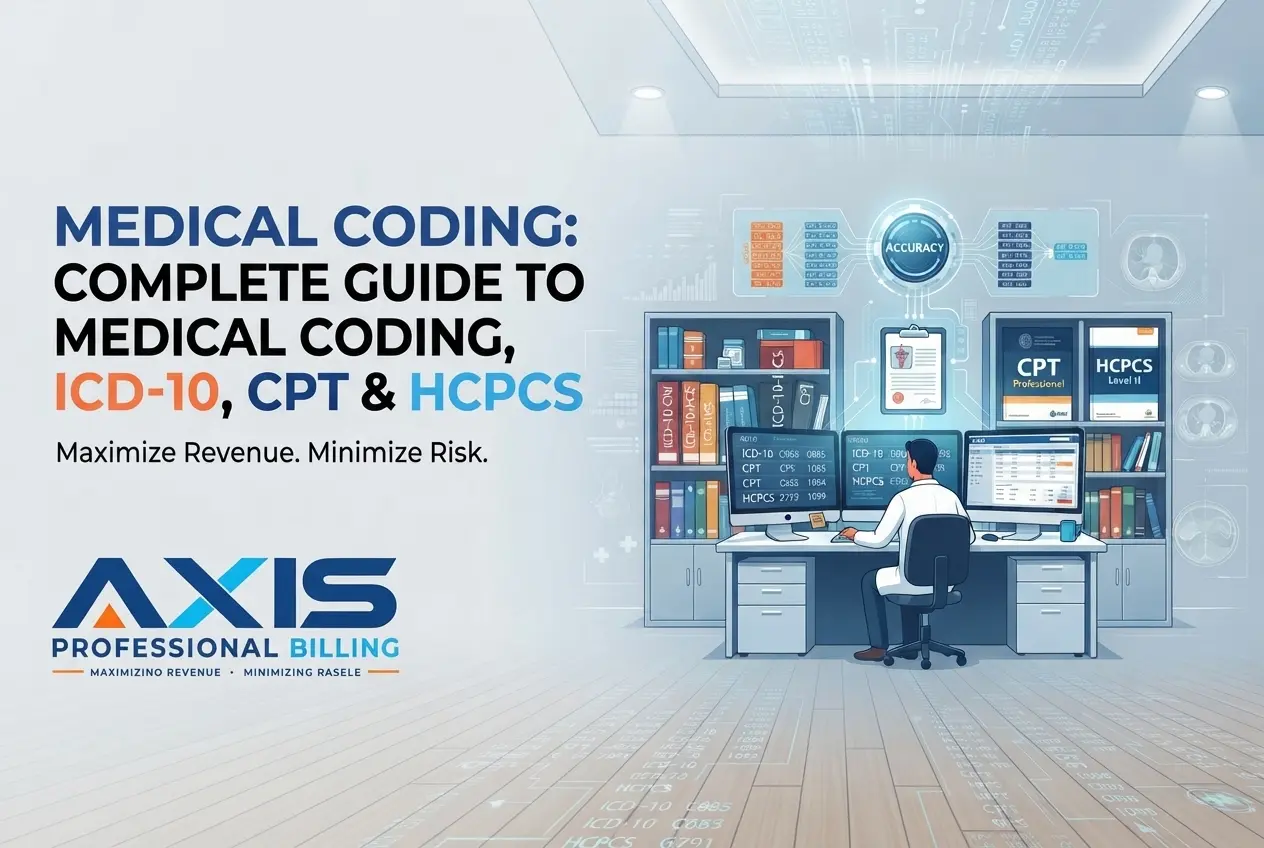
Medical coding is the process of translating documented diagnoses, procedures, services, treatments, and other relevant clinical information into standardized medical codes used throughout the healthcare system.
In the United States, medical coding plays a direct role in how healthcare services are documented, reported, submitted on claims, analyzed, and reimbursed. The most familiar code sets include ICD-10-CM for diagnoses, CPT for many physician and outpatient services, and HCPCS Level II for products, supplies, drugs, equipment, and services that are not represented by CPT.
But medical coding is more than choosing a code from a codebook.
A good coder has to understand the clinical documentation, identify what was actually performed, apply the appropriate coding guidelines, select the required level of specificity, use modifiers correctly when applicable, and make sure the reported services are supported by the record.
For a medical practice, that distinction matters. A coding error can affect claim submission, reimbursement, compliance, reporting, and the amount of administrative work required to correct a claim.
This guide explains how medical coding works, the major coding systems, the role of a medical coder, common coding challenges, the relationship between coding and medical billing, and practical ways practices can improve coding accuracy.
Quick Answer: What Is Medical Coding?
Medical coding is the process of converting information documented in a patient’s medical record into standardized healthcare codes.
These codes communicate important information about a patient encounter, including:
- Why the patient received care
- What services or procedures were performed
- What diagnoses or conditions were documented
- What supplies, equipment, drugs, or other services were provided when applicable
- Which details are relevant to reporting and reimbursement
In simple terms, ICD-10-CM generally answers “why,” while CPT and HCPCS codes help describe “what” was provided.
Medical coding is based on documentation. A coder should report what the medical record supports rather than choosing a code simply because it appears more specific or potentially more favorable for reimbursement.
CMS identifies ICD-10, HCPCS and CPT among the standardized code sets used in healthcare transactions, while CPT is maintained by the American Medical Association and HCPCS Level II is maintained by CMS.
Why Is Medical Coding Important?
Medical coding creates a standardized language that allows providers, payers, healthcare organizations, government programs, and other stakeholders to interpret clinical services consistently.
Without standardized coding, every payer and healthcare organization could describe the same service differently. That would make claims processing, reporting, payment, auditing, and healthcare data analysis considerably more difficult.
Accurate coding supports several parts of a healthcare organization.
1. Claims Processing
Medical codes are used to communicate diagnoses and services on healthcare claims. The payer uses the information on the claim, along with applicable policies and other data, to process the claim.
2. Reimbursement
Coding helps represent the services a provider performed and the diagnoses documented during an encounter. Accurate coding therefore supports appropriate claim reporting and reimbursement.
However, a code does not automatically guarantee payment. Coverage, medical necessity, payer policies, authorization requirements, documentation, and other claim requirements can affect whether a service is reimbursed. CMS specifically notes that the existence of a code alone does not establish Medicare coverage or payment.
3. Compliance
Medical records and claims need to accurately reflect the care that was actually provided and documented.
Unsupported codes, incorrect modifiers, inappropriate diagnosis selection, or reporting services beyond what documentation supports can create compliance concerns.
4. Clinical and Administrative Data
Coding data can also support reporting, healthcare analytics, quality initiatives, utilization analysis, and population health activities.
5. Revenue Cycle Performance
Coding sits early in the path from documentation to payment.
When coding is accurate and complete, claims can move into the billing process with fewer avoidable problems. When coding issues are discovered after submission, the practice may have to correct claims, respond to payer requests, work denials, or investigate payment discrepancies.
That is why medical coding should be treated as part of the revenue cycle rather than as an isolated administrative task.
How Does Medical Coding Work?
Medical coding starts with documentation, not with the codebook.
A typical coding workflow looks like this:
Clinical encounter → Documentation → Chart review → Code selection → Coding validation → Claim preparation → Claim submission → Payer processing → Payment or follow-up
Here is what happens at each stage.
Step 1: Review the Medical Record
The coder reviews the documentation associated with the patient encounter.
Depending on the service and setting, this may include:
- Provider notes
- History and examination information
- Diagnoses
- Procedure documentation
- Laboratory results
- Imaging reports
- Medication information
- Operative reports
- Treatment documentation
- Other supporting clinical records
The purpose is to understand what was documented and what services were actually provided.
Step 2: Identify Reportable Diagnoses
The coder determines which documented conditions, diagnoses, symptoms, or other relevant information should be reported according to the applicable coding guidelines and the setting of care.
The goal is not to code everything mentioned in a chart automatically. The coder has to determine what is relevant and supported.
Step 3: Identify Services and Procedures
Next, the coder identifies the services or procedures documented during the encounter.
For example, the record may describe an office visit, diagnostic procedure, surgical service, therapy treatment, laboratory service, or another healthcare service.
Step 4: Select the Appropriate Codes
The coder then uses the appropriate code set and current coding resources to identify the code that best represents the documented service or diagnosis.
This is where knowledge of coding guidelines becomes critical.
Step 5: Check Specificity and Modifiers
The coder reviews whether the selected code requires additional details or modifiers.
Modifiers can communicate specific circumstances surrounding a service. They are not simply tools for increasing reimbursement. A modifier should be used only when the documented circumstances support its use.
Step 6: Validate the Coding
Before the claim moves forward, coding should be reviewed for obvious inconsistencies, missing information, incorrect code combinations, unsupported specificity, and other issues relevant to the encounter.
Step 7: Send the Information Into the Billing Process
Once coding is complete, the coded information becomes part of the claim-building and billing workflow.
This is where medical coding and medical billing begin to overlap operationally, although they are not the same function.
What Are the Main Medical Coding Systems?
The U.S. healthcare system uses several standardized coding systems, each with a different purpose.
The three code sets most relevant to professional medical billing are:
- ICD-10-CM
- CPT
- HCPCS Level II
In hospital inpatient settings, ICD-10-PCS is also important.
ICD-10-CM
ICD-10-CM stands for International Classification of Diseases, 10th Revision, Clinical Modification.
It is primarily used to report diagnoses, conditions, symptoms, and reasons for healthcare encounters in the United States.
For example, an ICD-10-CM code can communicate that a patient has a particular condition or that a specific symptom was evaluated.
Think of ICD-10-CM as describing the clinical reason or diagnosis associated with the encounter.
CMS explains that ICD-10-CM is used by providers in healthcare settings to code diagnoses and is maintained by the CDC’s National Center for Health Statistics.
CPT
CPT stands for Current Procedural Terminology.
CPT codes are primarily used to report medical, surgical, diagnostic, and other professional services and procedures.
CPT is maintained by the American Medical Association.
CPT codes are organized into different categories and are used extensively in physician and outpatient reporting.
The AMA describes CPT as a standardized medical code set that supports communication about medical procedures and services and is updated through the CPT Editorial Panel.
HCPCS Level II
HCPCS stands for Healthcare Common Procedure Coding System.
HCPCS Level II codes are primarily used for products, supplies, equipment, drugs, ambulance services, and other services that are not represented by CPT.
HCPCS Level II codes generally use one letter followed by four numbers.
CMS maintains HCPCS Level II and regularly publishes updates to the code set.
ICD-10-PCS
ICD-10-PCS is a procedure coding system used primarily for procedures performed in the inpatient hospital setting.
It should not be confused with ICD-10-CM.
ICD-10-CM is primarily used for diagnoses, while ICD-10-PCS is used to classify inpatient hospital procedures.
ICD-10-CM vs CPT vs HCPCS: What Is the Difference?
| Code Set | Primary Purpose | Common Use |
|---|---|---|
| ICD-10-CM | Diagnoses and conditions | Explains why care was provided |
| CPT | Procedures and professional services | Describes many services performed |
| HCPCS Level II | Supplies, equipment, drugs and services outside CPT | DME, certain drugs, ambulance and other services |
| ICD-10-PCS | Inpatient procedures | Hospital inpatient procedure reporting |
The easiest way to remember the relationship is:
ICD-10-CM = Why
CPT = What service or procedure
HCPCS Level II = What additional product, supply, drug, equipment, or service is being reported
This is a simplified explanation. Actual coding depends on the healthcare setting, documentation, code set rules, payer requirements, and applicable coding guidelines.
What Does a Medical Coder Actually Do?
A medical coder is responsible for translating documented healthcare information into standardized codes.
That sounds straightforward until you look at what a coder has to consider before assigning a code.
A professional medical coder may need to:
- Read and interpret clinical documentation
- Understand medical terminology
- Understand anatomy and physiology
- Identify diagnoses and procedures
- Apply official coding guidelines
- Select appropriate ICD-10-CM codes
- Select appropriate CPT codes
- Select HCPCS Level II codes when applicable
- Apply modifiers when supported
- Review documentation for missing or conflicting information
- Identify potential coding inconsistencies
- Follow payer-specific requirements where applicable
- Stay current with annual code changes
- Support compliance and documentation accuracy
- Communicate with clinical or billing staff when clarification is needed
Coding is therefore a combination of clinical understanding, technical knowledge, attention to detail, and judgment based on documentation and coding rules.
Medical Coding and Medical Billing Are Not the Same
Medical coding and medical billing are closely connected, but they are different functions.
Medical Coding
The coder reviews clinical documentation and assigns the appropriate codes.
Medical Billing
The biller works with the coded information to prepare, submit, track, and follow up on claims and payments.
A simplified workflow looks like this:
Provider documents care
↓
Medical coder reviews documentation
↓
Codes are assigned
↓
Claim is prepared
↓
Claim is submitted
↓
Payer processes claim
↓
Payment, denial, rejection, or additional action
↓
Billing and A/R teams follow up
That is why coding accuracy has consequences beyond the coding department.
A coding issue discovered later in the revenue cycle can become a billing issue, a denial issue, an A/R issue, or a compliance issue.
What Makes Medical Coding Difficult?
The hardest part of medical coding is usually not finding a code.
The difficult part is deciding whether the code is actually supported by the documentation and whether it is being reported correctly under the applicable rules.
Several factors make coding challenging.
Constant Code Updates
Medical coding systems are not static.
Codes can be added, revised, deleted, or otherwise changed. Coding professionals therefore need to work with current resources rather than relying on an old codebook or outdated online information.
The AMA and CMS both maintain and update major U.S. code sets, and current-year resources are important for accurate coding.
Documentation Gaps
A coder cannot create clinical facts that are missing from the record.
If documentation does not support the level of detail required for a code, the appropriate response may involve clarification through the organization’s established process rather than simply selecting a more detailed code.
Modifier Errors
Modifiers can communicate important circumstances about a service, but using the wrong modifier can affect claim processing and create compliance concerns.
Diagnosis and Procedure Relationships
A diagnosis and a procedure cannot simply be paired because they seem related.
The documentation and applicable coding requirements must support the relationship being reported.
Specialty-Specific Requirements
Coding can become more complicated as the clinical specialty becomes more specialized.
Orthopedics, cardiology, behavioral health, physical therapy, surgery, pain management, DME, laboratory services, and other specialties can have very different documentation and coding considerations.
Common Medical Coding Errors
Coding errors do not all look the same.
Some are simple data-entry mistakes. Others involve deeper problems with documentation, code selection, modifiers, or coding guidelines.
Common examples include:
1. Using an Outdated Code
A code that was correct in a previous year may no longer be the correct code today.
2. Choosing a Code That Is Too General
If documentation supports a more specific code and the applicable guidelines require that specificity, using a broader code can reduce accuracy.
3. Reporting Unsupported Specificity
The opposite problem is just as important.
A coder should not select a highly specific code merely because it appears more complete if the medical record does not support that level of detail.
4. Incorrect Modifier Usage
A modifier should represent a documented circumstance that meets the requirements for that modifier.
5. Diagnosis Coding That Does Not Match Documentation
The diagnosis reported on a claim should be supported by the patient’s record and applicable coding guidelines.
6. Missing Relevant Documentation
Incomplete documentation can prevent accurate code assignment.
7. Ignoring Payer Requirements
A technically correct code does not mean every payer will process a claim in exactly the same way.
Payer policies, authorization requirements, medical necessity rules, claim edits, and other requirements can affect reimbursement.
How Accurate Medical Coding Helps Prevent Denials
Medical coding is only one part of denial prevention, but it is an important one.
A claim can encounter problems when the submitted codes do not accurately reflect the documentation or when required coding elements are missing or inconsistent.
A stronger coding process can help practices identify issues before claims are submitted.
For example, coding review can help detect:
- Incorrect diagnosis selection
- Unsupported procedures
- Missing modifiers
- Incorrect modifiers
- Code combinations that require review
- Documentation gaps
- Incorrect specificity
- Services that require additional information
- Potential payer-specific issues
However, practices should not treat every denial as a coding problem.
Denials can also result from eligibility, authorization, registration, claim formatting, payer policies, timely filing, medical necessity, coordination of benefits, or other revenue cycle issues.
That is why effective claim submission workflows and coding controls need to work together rather than operating separately.
Medical Coding in Different Healthcare Settings
Medical coding does not look identical across every healthcare environment.
Physician and Professional Coding
Professional coding commonly involves physician and other healthcare professional services.
Examples include:
- Office visits
- Evaluation and management services
- Procedures
- Diagnostic services
- Minor surgical services
- Preventive services
Outpatient Coding
Outpatient coding covers services delivered without an inpatient hospital admission.
Documentation, code selection, medical necessity, payer policies, and facility or professional billing rules can all affect the coding process.
Inpatient Coding
Inpatient hospital coding involves a different level of complexity and uses code sets and rules specific to inpatient hospital care.
ICD-10-PCS is used for inpatient procedure coding.
Specialty Coding
Specialty coding requires an understanding of the clinical language, procedures, documentation patterns, and payer considerations associated with a specific field.
For example, a physical therapy practice may have very different coding workflows from a pain management practice or DME provider.
For practices with specialty-specific workflows, coding should be designed around the actual services and documentation used by that practice rather than treated as a one-size-fits-all process.
What Is the Role of Documentation in Medical Coding?
Documentation is the foundation of accurate coding.
A coder does not determine what happened during an encounter independently. The medical record provides the evidence used to assign codes.
Strong documentation helps establish:
- The reason for the encounter
- The patient’s relevant diagnoses or conditions
- The services performed
- The procedures performed
- The medical decision-making or other applicable elements
- Relevant circumstances surrounding a service
- Supporting details required by the applicable coding rules
This is why coding accuracy cannot be fixed entirely inside the coding department.
Providers, clinical staff, coders, billers, and revenue cycle teams all contribute to the quality of the information that eventually appears on a claim.
How Practices Can Improve Medical Coding Accuracy
Improving coding accuracy is not about telling coders to “be more careful.”
A sustainable coding process needs systems behind it.
1. Use Current Coding Resources
Coding teams should work with current-year code sets and applicable official guidance.
2. Build Specialty-Specific Workflows
A practice should identify the procedures, diagnoses, modifiers, documentation requirements, and payer considerations that occur most frequently in its specialty.
3. Review High-Risk Coding Areas
Regular audits can identify recurring patterns instead of waiting for payers to identify them through denials.
4. Monitor Documentation Gaps
If the same documentation issue appears repeatedly, the solution may involve provider education rather than simply correcting individual claims.
5. Track Coding-Related Denials
Denial data can reveal whether certain services, providers, codes, modifiers, or documentation patterns repeatedly create problems.
6. Separate Coding Errors From Other Revenue Cycle Problems
Not every rejected claim is a coding error.
A practice should identify the actual root cause before changing its coding process.
7. Keep Communication Open
Coders should have an established process for requesting clarification when documentation does not adequately support code assignment.
Medical Coding Audits: Why They Matter
A coding audit is a structured review of medical records and assigned codes to identify accuracy, consistency, compliance, and process issues.
Audits can be:
- Internal
- External
- Routine
- Focused
- Provider-specific
- Specialty-specific
- Triggered by unusual denial patterns
- Triggered by payer activity
- Part of a compliance program
The purpose of an audit should not simply be to find someone who made a mistake.
A useful audit identifies why the mistake happened.
For example:
Was the problem caused by:
- Missing provider documentation?
- Incorrect code selection?
- An outdated reference?
- Training gaps?
- A misunderstood guideline?
- An incorrect modifier?
- An EHR workflow?
- A payer-specific requirement?
Finding the root cause makes the audit much more valuable.
Medical Coding and Revenue Cycle Management
Medical coding is one component of the larger revenue cycle.
A practice can have excellent coders and still experience revenue problems if other parts of the cycle are weak.
The broader process can include:
Credentialing
→ Eligibility Verification
→ Patient Registration
→ Documentation
→ Medical Coding
→ Claim Submission
→ Payer Adjudication
→ Payment Posting
→ Denial Management
→ A/R Follow-Up
→ Reporting and Analysis
This is why coding should be evaluated alongside the rest of the revenue cycle.
For example, accurate coding cannot compensate for inactive insurance coverage. Likewise, perfect eligibility verification cannot fix an unsupported procedure code.
Each part of the process has a different job.
Can Medical Coding Be Done With AI?
Yes, artificial intelligence and computer-assisted coding technologies are increasingly being used to support coding workflows.
AI and computer-assisted coding tools can help with tasks such as:
- Identifying potential diagnoses
- Suggesting codes
- Reviewing documentation
- Flagging possible inconsistencies
- Supporting chart review
- Improving workflow efficiency
But technology does not remove the need for qualified human review.
The central principle remains the same: the final coding decision must be supported by the documentation and applicable coding requirements.
AI-generated suggestions can be useful, but a suggested code is not automatically a correct code.
Human oversight remains particularly important when documentation is ambiguous, the clinical circumstances are complex, or coding and compliance rules require interpretation.
How Do Medical Coders Stay Current?
Medical coding changes continuously, so professional development is part of the job.
Coders commonly stay current through:
- Annual codebook updates
- Official coding guidance
- CMS resources
- AMA CPT resources
- Professional education
- Coding newsletters
- Training programs
- Audits and feedback
- Specialty-specific education
- Payer updates
- Organizational coding policies
The AMA provides current CPT coding resources, while CMS provides official information for HCPCS and other coding systems.
For certification preparation, organizations such as AAPC also test knowledge of CPT, HCPCS Level II, ICD-10-CM, and coding scenarios.
What Should a Practice Look for in a Medical Coding Service?
If a practice is considering outsourced medical coding, price should not be the only consideration.
Look at the coding process itself.
Important questions include:
Does the coding team understand your specialty?
Specialty knowledge can matter because documentation, procedures, payer rules, and coding patterns differ between practices.
How is coding accuracy measured?
Ask whether the organization performs quality reviews or audits and how coding errors are tracked.
How are documentation issues handled?
There should be a clear process for communicating documentation gaps without encouraging unsupported coding.
How are annual code updates handled?
The team should have a defined process for keeping its coding resources current.
How does coding connect with billing?
Coding should not operate in isolation from claims, denials, A/R, and other revenue cycle functions.
How are recurring errors identified?
A strong process should look for patterns rather than repeatedly fixing the same individual claim problem.
For practices looking for broader support, medical billing and revenue cycle services can connect coding with claim submission, denial follow-up, A/R recovery, and other revenue cycle functions.
Medical Coding FAQ
What is medical coding in simple terms?
Medical coding is the process of converting documented diagnoses, procedures, services, and other relevant healthcare information into standardized codes used for healthcare reporting, claims processing, reimbursement, and other purposes.
What are the three main medical coding systems?
The three major code sets commonly encountered in U.S. professional medical billing are ICD-10-CM, CPT, and HCPCS Level II.
ICD-10-CM primarily describes diagnoses. CPT primarily describes procedures and professional services. HCPCS Level II primarily describes certain supplies, equipment, drugs, and services not represented by CPT.
Is medical coding the same as medical billing?
No. Medical coding involves assigning standardized codes to documented healthcare information. Medical billing involves preparing, submitting, tracking, and following up on claims and payments. The two functions work closely together.
Why is accurate medical coding important?
Accurate coding helps ensure that healthcare services and diagnoses are represented correctly on claims and in healthcare records. It can support appropriate reimbursement, reduce avoidable claim problems, support compliance, and improve the quality of healthcare data.
What happens when medical coding is incorrect?
Incorrect coding can contribute to claim rejections, denials, payment delays, inaccurate reporting, rework, or compliance concerns. The impact depends on the nature of the coding issue and the applicable payer and coding requirements.
What is the difference between ICD-10-CM and CPT?
ICD-10-CM is primarily used to report diagnoses and conditions. CPT is primarily used to report medical procedures and professional services.
A simple way to remember the difference is that ICD-10-CM generally describes why care was provided, while CPT describes what service or procedure was provided.
What is HCPCS Level II used for?
HCPCS Level II is primarily used to report products, supplies, equipment, drugs, ambulance services, and other services that are not represented by CPT.
Can AI replace medical coders?
AI and computer-assisted coding can support coding workflows, but automated suggestions still need appropriate human oversight. Coding must remain grounded in the medical record, current coding rules, and applicable compliance requirements.
How often do medical codes change?
Medical code sets are updated regularly. Some changes occur annually, while additional updates can occur during the year depending on the code set and responsible organization. Practices should use current official resources rather than relying on outdated coding information.
Does having a medical code guarantee payment?
No. The existence of a code does not by itself guarantee coverage or reimbursement. Payment can depend on factors such as documentation, medical necessity, payer policy, eligibility, authorization, claim requirements, and other applicable rules.
The Bottom Line
Medical coding is the connection between what happens during a healthcare encounter and how that encounter is represented in the healthcare system.
It turns clinical documentation into standardized information that can be used for claims, reimbursement, reporting, compliance, analytics, and other healthcare functions.
The most important principle is simple:
Code what the documentation supports, follow the applicable coding rules, and keep the coding process current.
For healthcare practices, accurate coding should also be viewed as part of the larger revenue cycle. Coding, claim submission, denial management, A/R follow-up, eligibility, and payment processes all influence what happens after a patient receives care.
When these functions work together, a practice has a stronger foundation for accurate claims, cleaner workflows, and better visibility into its revenue cycle.
If your practice needs help connecting medical coding with the rest of its revenue cycle, explore Axis Professional Billing’s medical billing services to see how coding, claims, denial management, A/R recovery, and other billing functions can work together under one revenue cycle workflow.