Medical billing and medical coding are often mentioned together, but they are not the same job and they do not perform the same function.
The easiest way to understand the difference is this:
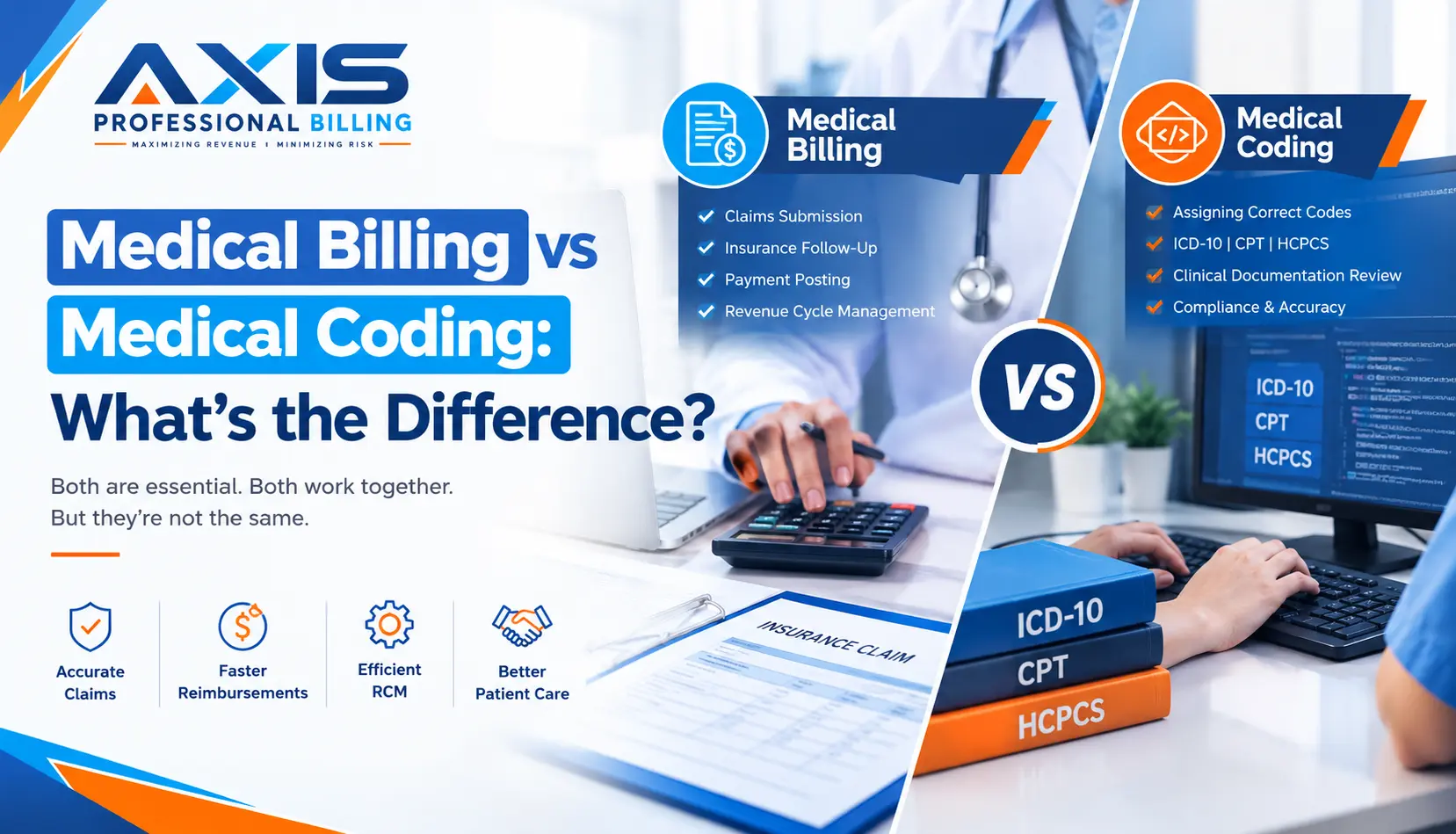
Medical coding translates clinical documentation into standardized codes. Medical billing uses that coded information to prepare, submit, track, and follow up on claims so the healthcare provider can receive payment.
Coding is primarily concerned with accurately representing what happened during a patient encounter. Billing is primarily concerned with moving that information through the claims and reimbursement process.
The two functions are closely connected. A coding error can contribute to a claim problem, while a billing error can prevent an otherwise correctly coded service from being paid. In smaller practices, one employee may handle both responsibilities. In larger organizations, the work is often divided among specialized teams.
If you are comparing medical billing vs medical coding as a career, or you are a practice owner trying to understand what each function does, this guide breaks down the difference from both perspectives.
Medical Billing vs Medical Coding: Quick Answer
Medical coding is the process of reviewing clinical documentation and assigning standardized codes that describe diagnoses, procedures, services, and other billable items.
Medical billing is the process of using coded information and other claim data to prepare and submit claims, monitor their status, resolve billing problems, post payments, manage denials, and follow up on outstanding balances.
In simple terms:
Coding answers: “What diagnosis, procedure, or service is documented?”
Billing answers: “How do we correctly submit that information and get the provider paid?”
Neither function replaces the other. They work together as part of the broader healthcare revenue cycle.
Medical Billing vs Medical Coding at a Glance
| Medical Coding | Medical Billing |
|---|---|
| Reviews clinical documentation | Works with coded claim information |
| Assigns diagnosis and procedure codes | Prepares and submits claims |
| Uses code sets and coding guidelines | Works with payer and claim requirements |
| Focuses heavily on coding accuracy | Focuses heavily on claim accuracy and reimbursement |
| Reviews documentation for code selection | Tracks claim status and payer responses |
| May query providers when documentation is unclear | Follows up on rejected and denied claims |
| Supports compliant reporting and reimbursement | Supports payment collection and accounts receivable |
| More documentation and analysis focused | More claims, payer, and follow-up focused |
The important point is that these are not two unrelated departments. They are connected steps in the same financial workflow.
What Is Medical Coding?
Medical coding is the process of converting information from a patient’s medical record into standardized codes.
A healthcare provider may document a diagnosis, examination, procedure, treatment, test, or other service in the patient’s record. A medical coder reviews that documentation and determines which applicable codes accurately represent the documented care.
Common code sets used in U.S. healthcare include:
- ICD-10-CM for diagnoses
- CPT for many physician and other professional services and procedures
- HCPCS Level II for certain products, supplies, services, and items not represented by CPT
CMS explains that HCPCS has two primary levels. Level I consists of CPT codes maintained by the American Medical Association, while Level II is used primarily for products, supplies, and services outside the CPT code set.
ICD-10-CM is used to report diagnoses, while procedure and service coding uses other applicable code sets depending on the setting and service.
Coding is not simply looking up a diagnosis in a book.
A coder has to interpret the provider’s documentation, apply applicable coding guidelines, evaluate the details available in the record, and select codes that accurately represent the documented service.
That distinction matters.
A coder should not choose a code simply because it produces a higher reimbursement. The documentation has to support the reported service and diagnosis.
What Does a Medical Coder Do?
A medical coder may be responsible for tasks such as:
- Reviewing physician and other clinical documentation
- Identifying documented diagnoses
- Identifying procedures and services performed
- Assigning appropriate ICD-10-CM codes
- Assigning applicable CPT and HCPCS codes
- Reviewing modifiers when applicable
- Checking coding guidelines and payer requirements
- Reviewing documentation for completeness
- Identifying potential coding inconsistencies
- Communicating with providers when clarification is needed
- Supporting coding quality and compliance
- Correcting coding errors identified during review
The exact responsibilities vary by healthcare setting, specialty, employer, and type of coding work.
For example, coding for a primary care practice can involve a different mix of documentation and services than coding for surgery, orthopedics, behavioral health, or other specialties.
What Is Medical Billing?
Medical billing begins with the information generated during the healthcare encounter and moves it through the reimbursement process.
Once services have been documented and appropriately coded, the billing process uses that information along with patient, provider, insurance, and claim information to create and submit the claim.
But medical billing does not end when a claim is submitted.
A biller may also monitor claim status, investigate rejections, work denials, communicate with payers, post payments and adjustments, manage patient balances, and follow up on outstanding accounts receivable.
For professional claims, CMS identifies the CMS-1500 as the standard paper claim form when paper submission is permitted, while the 837P is the electronic professional claim format.
That is why calling medical billing simply “sending bills to insurance companies” is too narrow.
Medical billing is part of the ongoing process of turning documented healthcare services into collected revenue.
What Does a Medical Biller Do?
Depending on the organization, a medical biller’s responsibilities may include:
- Entering or validating patient and insurance information
- Reviewing charges and coded information
- Preparing claims
- Submitting electronic claims
- Monitoring claim acceptance and status
- Correcting claim rejections
- Following up on unpaid claims
- Working payer requests
- Investigating denials
- Submitting corrected claims when appropriate
- Supporting appeals
- Posting insurance payments
- Posting adjustments
- Reviewing patient balances
- Following up on accounts receivable
- Communicating with patients about billing questions
- Reporting claim and payment issues to practice management
A strong billing process therefore requires more than data entry.
The biller needs to understand the claim, the payer requirements, the reason something was rejected or denied, and what action should be taken next.
Medical Billing vs Medical Coding: The Biggest Difference
The biggest difference comes down to function and timing.
Medical coding converts clinical documentation into standardized codes.
Medical billing takes the coded information and moves it through the reimbursement process.
Think of a typical physician encounter.
A provider sees a patient and documents the visit.
The coder reviews the documentation and assigns the appropriate diagnosis and procedure codes.
The billing team then uses those codes with the required claim information to prepare the claim.
The claim is submitted to the appropriate payer.
The payer processes the claim and sends a payment, rejection, denial, or other response.
The billing team then works the response and follows the claim through to resolution.
This means coding is an important input into billing, but billing involves substantially more than coding.
How Medical Billing and Coding Work Together
Consider a simple example.
A patient visits a physician for evaluation of a documented condition. The provider records the history, examination, assessment, and services performed.
The process may look like this:
1. Patient receives care
The provider performs and documents the services.
2. Documentation is reviewed
The coder evaluates the medical record.
3. Codes are assigned
Applicable diagnosis and procedure codes are selected based on the documentation.
4. Claim is prepared
The billing process combines the coded information with required patient, provider, payer, and claim data.
5. Claim is submitted
The claim is transmitted electronically or submitted using an applicable paper process.
6. Payer processes the claim
The payer may accept, reject, deny, or adjudicate the claim.
7. Payment is posted
Payments and applicable adjustments are recorded.
8. Outstanding issues are worked
Rejected or denied claims may require correction, additional information, reconsideration, or appeal depending on the circumstances.
9. A/R is followed
Outstanding balances are monitored and worked according to the practice’s policies.
This is where the relationship between coding and billing becomes clear.
A problem introduced during coding can create downstream billing consequences. A billing problem can also occur even when the coding itself is correct.
Medical Coding vs Medical Billing: Codes, Claims and Payments
One of the easiest ways to understand the distinction is to look at what each role primarily handles.
Medical coding focuses on:
Clinical documentation → standardized codes
The coder works primarily with:
- Medical records
- Provider documentation
- Diagnosis information
- Procedures
- Services
- Coding guidelines
- CPT
- ICD-10-CM
- HCPCS
- Applicable modifiers and related coding requirements
Medical billing focuses on:
Coded information → claim → payer response → payment
The biller works primarily with:
- Claims
- Patient information
- Insurance information
- Provider information
- Payer requirements
- Claim status
- Rejections
- Denials
- Remittance information
- Payments
- Adjustments
- Patient balances
- Accounts receivable
CMS documentation for professional claims shows how diagnosis and procedure information forms part of the claim data, alongside dates of service, charges, units, amounts paid, and other required information.
Why Coding Accuracy Matters to Medical Billing
A claim can only be as reliable as the information supporting it.
Incorrect or unsupported coding can contribute to:
- Claim denials
- Payment delays
- Incorrect reimbursement
- Rework
- Compliance concerns
- Additional documentation requests
- Patient billing issues
At the same time, not every denial is a coding problem.
A claim can have accurate codes and still encounter issues involving eligibility, authorization, timely filing, provider information, claim formatting, payer rules, or other administrative requirements.
That is why experienced revenue cycle teams look beyond the code itself.
The question is not simply, “Was the code entered?”
The better question is, “Did the complete claim accurately represent the documented service and meet the requirements needed for processing?”
Medical Billing vs Medical Coding: Skills Compared
Although both roles require attention to detail, their day-to-day skill sets can differ.
Skills Used in Medical Coding
Medical coders generally need strong abilities in:
- Medical terminology
- Anatomy and physiology
- Clinical documentation review
- Coding guidelines
- Code-set research
- Analytical thinking
- Attention to detail
- Documentation interpretation
- Compliance awareness
Coding requires patience.
Two codes may look similar but represent different circumstances. Small documentation details can change the appropriate coding decision.
Skills Used in Medical Billing
Medical billers generally benefit from strong abilities in:
- Claims processing
- Insurance terminology
- Payer research
- Communication
- Problem solving
- Follow-up
- Organization
- Accounts receivable management
- Payment posting
- Denial investigation
- Practice management systems
Billing also requires persistence.
A claim that has not been paid is not necessarily finished. Someone has to determine why it has not been paid and what action is appropriate.
Medical Billing vs Medical Coding: Education and Certification
Education and certification expectations vary by employer, healthcare setting, role, and experience.
Medical coding roles often place greater emphasis on formal coding education and professional credentials. Examples of industry credentials include certifications offered through organizations such as AAPC and AHIMA.
Medical billing roles can have different entry requirements, and some employers provide on-the-job training or prioritize experience with billing systems and payer workflows.
Some education programs combine medical billing and coding because the two disciplines are closely related.
That can be useful for someone who wants exposure to the entire revenue cycle before specializing.
The important point is not to assume that one universal education requirement applies to every medical biller or every medical coder.
Job descriptions should always be reviewed individually.
Medical Billing vs Medical Coding: Which Is More Difficult?
There is no universal answer.
The difficulty depends on the person, the role, the specialty, the complexity of the documentation, and the responsibilities involved.
Medical coding can be demanding because it requires careful interpretation of documentation and detailed knowledge of coding rules.
Medical billing can be demanding because it requires constant interaction with payer requirements, claim problems, denials, payment issues, and outstanding accounts.
Someone who enjoys research, clinical documentation, rules, and detail may find coding more natural.
Someone who enjoys communication, troubleshooting, payer follow-up, and solving payment problems may prefer billing.
Neither role should be reduced to “easy office work.” Both affect the financial and administrative side of healthcare.
Medical Billing vs Medical Coding as a Career
If you are considering these fields as a career, look beyond the job title.
Ask what you would actually spend most of your day doing.
Medical coding may involve more:
- Documentation review
- Code research
- Clinical terminology
- Coding guidelines
- Accuracy checks
- Compliance-related work
- Independent analytical work
Medical billing may involve more:
- Claims
- Payer communication
- Claim status
- Denial follow-up
- Payment posting
- Accounts receivable
- Patient billing questions
- Administrative problem solving
Some employers combine the roles.
In a small physician practice, one employee may register patients, verify insurance, enter charges, code encounters, submit claims, post payments, and work outstanding balances.
In a larger healthcare organization, those responsibilities may be separated among several teams.
So when comparing career opportunities, read the actual job description rather than relying only on the title.
Can One Person Do Both Medical Billing and Medical Coding?
Yes.
Many organizations combine billing and coding responsibilities, especially smaller practices and organizations with limited administrative staff.
However, combining the roles does not mean that billing and coding have become the same function.
The person is simply performing two related functions.
This distinction becomes important as a practice grows.
A workflow that works well when one person handles everything may need more specialized roles, quality controls, reporting, and oversight as claim volume and organizational complexity increase.
Medical Billing vs Medical Coding for a Medical Practice
For healthcare providers, the question is slightly different.
Instead of asking, “Which one is better?” the more useful question is:
Where are problems occurring in the revenue cycle?
If documentation and coding accuracy are creating downstream issues, the practice may need stronger coding processes.
If claims are being rejected, denied, delayed, or left unresolved, the billing workflow may need attention.
If eligibility problems are creating avoidable claim issues, front-end verification may be part of the solution.
If unpaid claims are aging without consistent follow-up, accounts receivable management becomes important.
This is why medical billing and coding should be viewed as connected parts of a larger revenue cycle rather than isolated administrative tasks.
For example, effective eligibility verification can help identify coverage information and authorization requirements before services are provided, while effective claim submission focuses on getting complete claims into the payer workflow correctly.
Once claims have been processed, unresolved balances may require structured AR recovery and payer follow-up.
A Real-World Example: Where Billing and Coding Can Diverge
Imagine a provider performs a service and documents it appropriately.
The coder reviews the documentation and selects the applicable codes.
At first glance, everything looks correct.
The billing team then prepares the claim.
However, the claim may still encounter a problem because of something unrelated to the underlying code selection.
For example, there could be an issue involving eligibility, authorization, claim information, provider data, filing requirements, or payer-specific rules.
The reverse can happen too.
The billing process may be technically correct, but the underlying coding may not accurately reflect the documentation.
The result is the same from the practice’s perspective: additional work, delayed reimbursement, and potentially lost revenue.
This is why strong revenue cycle management depends on communication between coding and billing instead of treating each department as a separate island.
Common Misconceptions About Medical Billing and Coding
“Medical billing and medical coding are the same thing.”
They are closely connected, but they are different functions.
Coding creates standardized representations of documented healthcare services and diagnoses. Billing uses that information to support claims and reimbursement.
“Medical coders only enter codes.”
Good coding involves much more than typing numbers into software.
Coders review documentation, interpret clinical information, apply coding guidelines, and make careful code-selection decisions.
“Medical billers only submit claims.”
Claim submission is only one part of billing.
Billing can also include claim monitoring, rejection correction, denial work, payment posting, patient balances, and accounts receivable follow-up.
“Every denial is caused by coding.”
No.
Denials can result from many different issues. Coding is one possible factor, but eligibility, authorization, filing deadlines, provider information, payer policies, claim data, and other issues can also affect claim processing.
“A medical billing and coding employee always performs both jobs.”
Not necessarily.
Some organizations combine the responsibilities, while others have separate coding and billing teams.
Medical Billing vs Medical Coding: How They Fit Into the Revenue Cycle
The relationship becomes even clearer when viewed as a complete process:
Patient scheduling
↓
Registration and insurance information
↓
Eligibility and authorization
↓
Patient encounter
↓
Clinical documentation
↓
Medical coding
↓
Charge and claim preparation
↓
Claim submission
↓
Payer adjudication
↓
Payment or denial
↓
Payment posting and reconciliation
↓
Denial and A/R follow-up
↓
Patient balance management
The exact workflow varies by organization and payer, but the concept remains the same.
Coding sits at the point where clinical documentation is translated into standardized coding information.
Billing carries that information into the claims and reimbursement process.
Why Medical Practices Need Both Functions to Work Well
A practice can have excellent coders and still have billing problems.
It can also have experienced billers and still struggle because the underlying documentation or coding process is inconsistent.
The strongest revenue cycle workflows connect the two.
That means:
- Coding teams understand how their work affects claims.
- Billing teams understand enough about coding to identify potential issues.
- Providers understand the importance of complete documentation.
- Front-end teams capture accurate patient and insurance information.
- Denial teams communicate recurring problems back to the appropriate department.
- Management uses reporting to identify patterns rather than treating every claim problem as an isolated incident.
This feedback loop is one of the most important differences between simply processing claims and actively managing a revenue cycle.
Medical Billing vs Medical Coding: Which One Should You Choose?
If you are considering a career, your decision should depend on the type of work you prefer.
Medical coding may be a better fit for someone who enjoys:
- Clinical documentation
- Research
- Medical terminology
- Detailed rules
- Analytical work
- Accuracy-focused tasks
Medical billing may appeal more to someone who enjoys:
- Communication
- Claims
- Insurance processes
- Problem solving
- Follow-up
- Payment and A/R management
There is also a third option.
You can develop knowledge of both.
Understanding how coding affects billing, and how billing problems can reveal coding or documentation issues, can provide a broader view of the healthcare revenue cycle.
Frequently Asked Questions
Is medical billing the same as medical coding?
No. Medical coding converts clinical documentation into standardized codes, while medical billing uses coded information and other claim data to submit, track, and resolve claims and manage reimbursement.
Which comes first, medical billing or medical coding?
In a typical professional claim workflow, coding occurs before the claim is prepared and submitted. The coder reviews documentation and assigns applicable codes, and the billing process uses that information to build and submit the claim.
What is the difference between a medical biller and a medical coder?
A medical coder primarily works with clinical documentation and code assignment. A medical biller primarily works with claims, payer processes, payments, denials, and accounts receivable.
Do medical billers need to know medical coding?
They do not necessarily perform the coder’s job, but understanding coding concepts can help billers identify potential claim problems and communicate more effectively with coding teams.
Do medical coders handle insurance claims?
Typically, claim submission and payment follow-up are billing responsibilities, although the exact division of duties varies by organization. Some employees perform both billing and coding.
Is medical coding harder than medical billing?
Neither is universally harder. Coding requires detailed documentation analysis and coding knowledge, while billing requires knowledge of claims, payer requirements, follow-up, denials, payments, and accounts receivable.
Can medical billing and coding be done remotely?
Many administrative healthcare roles can be performed remotely when the employer has appropriate systems, security controls, workflows, and job requirements. Whether a specific position is remote depends on the employer.
Do small medical practices need both medical billing and medical coding?
They need both functions, but they do not necessarily need two separate employees. In smaller practices, one person or an outsourced team may handle multiple parts of the billing and coding workflow.
Why do medical billing and coding errors matter?
Errors can lead to claim rework, payment delays, denials, inaccurate reimbursement, or additional administrative work. The effect depends on the type and severity of the error.
How are medical billing and coding connected to revenue cycle management?
Coding provides standardized information from clinical documentation, while billing moves that information through the claims and reimbursement process. Both contribute to the larger revenue cycle.
Final Takeaway: Medical Billing vs Medical Coding
Medical billing and medical coding are two different functions that depend on each other.
Medical coding translates documentation into accurate standardized codes.
Medical billing turns that information into claims and manages the process of getting those claims paid.
Coding focuses heavily on documentation, code selection, and accuracy.
Billing focuses heavily on claims, payer requirements, reimbursement, denials, payments, and accounts receivable.
The strongest healthcare revenue cycle workflows do not treat these functions as competing responsibilities. They connect them.
When coding, documentation, billing, claims, and follow-up work together, healthcare organizations have a clearer path from the patient’s encounter to accurate reimbursement.
For practices that want to strengthen the entire process rather than address one isolated problem, revenue cycle management brings these connected functions into a broader financial workflow.
Sources and Technical References
For current coding and claims requirements, healthcare organizations should rely on the applicable official coding manuals, payer guidance, CMS requirements, and other authoritative sources. CMS provides current information on ICD-10, HCPCS, professional claims, CMS-1500, and 837P electronic claim standards.