
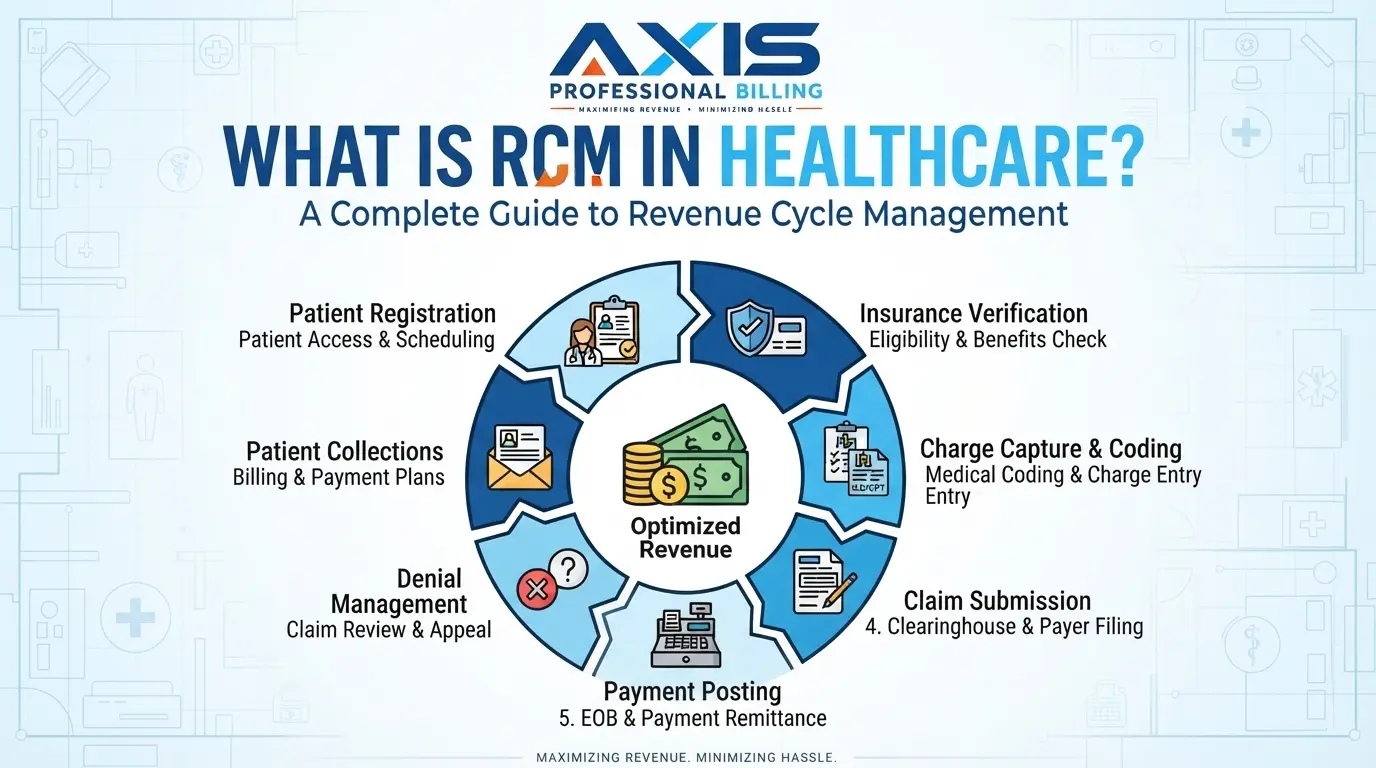
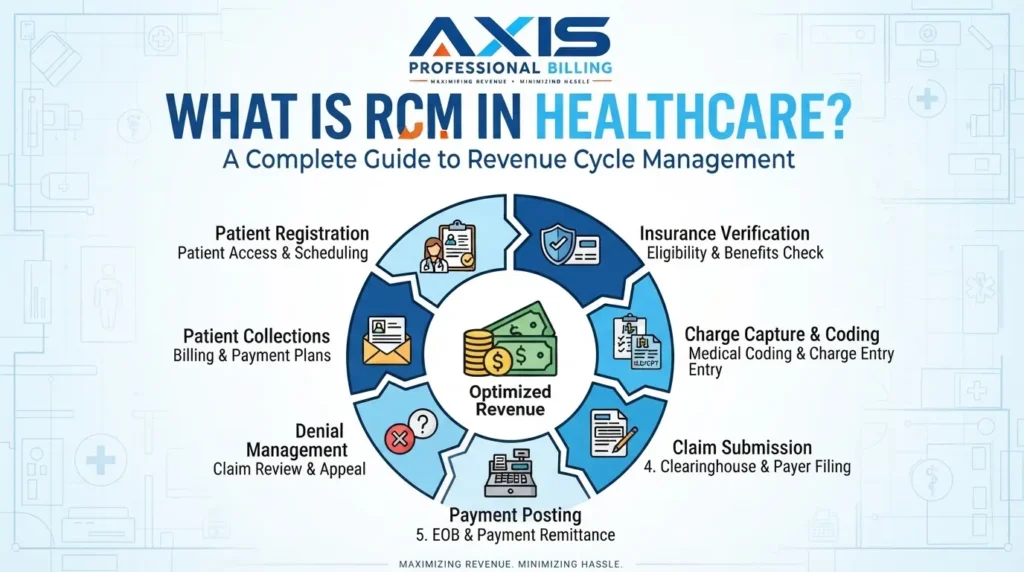
If you run a medical practice, getting paid for the care you provide is not as simple as sending a claim to an insurance company.
Revenue moves through a series of connected steps before it reaches your practice. A patient has to be registered correctly. Insurance coverage needs to be verified. Authorizations may be required. Services must be documented and coded correctly. Charges have to be captured, claims submitted, payments posted, and unpaid balances followed up.
The system that connects these activities is called revenue cycle management, or RCM.
What Is RCM in Healthcare?
Revenue cycle management (RCM) is the complete process healthcare organizations use to manage the financial side of patient care, from the initial appointment or registration through claim processing, payment, and final collection.
In practical terms, RCM makes sure that the services a healthcare provider delivers are accurately documented, properly coded, billed to the appropriate payer, followed through the payment process, and collected correctly.
The Healthcare Financial Management Association describes RCM as the process of tracking healthcare revenue from the patient’s initial encounter through final payment.
That means RCM is much broader than medical billing.
Medical billing is an important part of RCM, but the revenue cycle begins before a claim is created and continues after that claim has been submitted.
For a medical practice, the cycle may include:
- Patient scheduling and pre-registration
- Insurance eligibility and benefits verification
- Prior authorization
- Patient registration
- Clinical documentation
- Charge capture
- Medical coding
- Claim creation and submission
- Payer adjudication
- Payment posting
- Denial management
- Accounts receivable follow-up
- Patient billing and collections
- Revenue reporting and analytics
The goal is not simply to send more claims. The goal is to create a connected process that helps the practice receive accurate reimbursement with fewer preventable delays.
How Does Revenue Cycle Management Work?
A simple way to understand RCM is to follow one patient encounter from beginning to end.
Imagine a patient schedules an appointment with a physician.
Before the appointment, the practice verifies the patient’s insurance and determines whether the planned service requires authorization. During the visit, the provider documents the services performed. Those services are translated into appropriate medical codes.
The billing team then captures the charges, prepares the claim and submits it to the payer.
The insurance company processes the claim and sends a payment or explanation of benefits. The payment is posted to the patient’s account. If the payer denies the claim or pays less than expected, the account enters another workflow for investigation and follow-up.
Any remaining patient responsibility is billed to the patient.
The cycle is complete when the amount owed has been appropriately resolved and recorded.
This is why RCM is often described as an end-to-end financial process rather than a single billing task.
The 10 Key Steps of RCM in Healthcare
Although organizations may divide the revenue cycle into different numbers of stages, the following framework gives medical practices a practical view of the entire process.
1. Patient Scheduling and Pre-Registration
The revenue cycle starts before the patient walks into the office.
During scheduling and pre-registration, staff may collect demographic information, insurance details, appointment information and other data needed for the encounter.
This stage matters because inaccurate information can create problems later.
A misspelled name, incorrect date of birth, outdated insurance information or incomplete payer details can contribute to claim rejection and payment delays.
Good RCM starts with accurate information.
2. Insurance Eligibility and Benefits Verification
Eligibility verification confirms whether a patient’s insurance is active and helps the practice understand the patient’s coverage.
Depending on the payer and service, the process may include checking:
- Active coverage
- Deductible
- Copayment
- Coinsurance
- Benefit limitations
- Provider network status
- Referral requirements
- Authorization requirements
Verifying this information before treatment can help prevent avoidable billing problems later.
For example, if a service requires authorization and the practice discovers that requirement only after the claim is submitted, fixing the problem may be significantly more difficult.
A strong RCM workflow therefore treats eligibility as a revenue-protection activity, not merely an administrative task.
3. Prior Authorization
Some healthcare services require payer approval before treatment.
Prior authorization may involve submitting clinical information, documentation and other supporting material to the payer.
When authorization is required, missing or incomplete information can create delays and reimbursement risk.
This is one reason front-end RCM matters so much. Problems that appear later as claim denials often begin much earlier in the revenue cycle.
4. Patient Registration and Check-In
At registration, the practice confirms patient information and insurance details.
This can include:
- Demographic information
- Insurance information
- Identification
- Guarantor information
- Referrals
- Financial responsibility
- Required forms
Accurate registration creates a cleaner foundation for everything that follows.
When registration data is incorrect, the error can travel through the entire cycle and eventually appear as a rejected or denied claim.
5. Clinical Documentation and Charge Capture
After the patient receives care, the services provided need to be documented appropriately.
Charge capture connects the clinical work performed by the provider with the financial side of the encounter.
If a service is provided but not captured correctly, the practice may never bill for it.
That makes charge capture an important revenue-integrity checkpoint.
The objective is not to charge for services that were not provided. It is to make sure that services that were appropriately provided and documented are not accidentally missed.
6. Medical Coding
Medical coding translates documented healthcare services and diagnoses into standardized codes.
Common coding systems include:
- ICD-10-CM
- CPT
- HCPCS
Accurate coding matters because the codes on a claim help communicate what was diagnosed, what services were performed and why those services were medically appropriate.
Coding errors can contribute to rejected or denied claims, incorrect reimbursement and compliance concerns.
This is also why RCM and medical coding should not be treated as completely separate functions.
A strong revenue cycle connects documentation, coding and billing rather than allowing each department to work in isolation.
7. Claim Creation and Submission
Once the necessary information is available, the claim is prepared and submitted to the appropriate payer.
Before submission, billing teams may check the claim for common errors involving:
- Patient information
- Provider information
- Insurance details
- Diagnosis codes
- Procedure codes
- Modifiers
- Authorization information
- Required documentation
The objective is to submit a claim that is accurate, complete and compliant with applicable payer requirements.
Axis Professional Billing’s claim workflow, for example, emphasizes validation and payer-specific requirements as part of its claim submission process.
8. Payer Adjudication and Payment Posting
After a claim reaches the payer, it goes through adjudication.
The payer determines how the claim will be processed according to the patient’s benefits, provider contract, coding, documentation and other applicable rules.
The result may be a payment, partial payment, denial or another payer response.
When payment is received, it needs to be posted accurately to the patient’s account.
Payment posting typically involves recording:
- Insurance payments
- Patient payments
- Contractual adjustments
- Other adjustments
- Remaining patient responsibility
Accurate payment posting gives the practice a reliable picture of what has actually been paid and what remains outstanding.
9. Denial Management and A/R Follow-Up
Not every claim gets paid correctly on the first attempt.
A claim may be denied because of eligibility problems, authorization issues, coding errors, missing information, medical necessity concerns, timely filing issues or other payer-specific requirements.
Effective denial management goes beyond simply resubmitting the same claim.
The billing team needs to identify why the claim was denied, determine what corrective action is appropriate, submit the necessary correction or appeal, and track the outcome.
At the same time, accounts receivable teams follow up on unpaid and underpaid claims.
This is where RCM becomes especially important for cash flow.
An unpaid claim is not simply an accounting entry. It represents revenue that the practice has earned but has not yet collected.
Axis describes its A/R workflow as tracking unpaid claims, following up with payers and resolving outstanding balances.
10. Patient Billing, Collections and Reporting
After insurance processing, some balances may remain the patient’s responsibility.
The practice needs a process for communicating those balances clearly and collecting them appropriately.
At the same time, RCM reporting helps management understand what is happening across the revenue cycle.
Useful reporting can show:
- Claim volume
- Denial trends
- A/R aging
- Payment trends
- Collection performance
- Payer performance
- Outstanding balances
- Coding or billing issues
- Revenue leakage
Without reporting, a practice may know that collections are down without knowing why.
With useful RCM analytics, management can identify where the process is breaking down and address the underlying problem.
What Is the Difference Between RCM and Medical Billing?
This is one of the most common questions about healthcare revenue cycle management.
Medical billing is one component of RCM. RCM covers the broader financial lifecycle of a patient encounter.
Medical billing generally focuses on preparing, submitting and following up on claims and payments.
RCM goes beyond the claim.
It can include patient access, eligibility verification, authorization, charge capture, coding, claim submission, payment posting, denial management, A/R follow-up, patient collections and financial reporting.
A simple way to remember the difference is:
Medical billing asks, “How do we bill and collect this claim?”
RCM asks, “How do we manage the entire process that turns patient care into collected revenue?”
That distinction is important for practices that are trying to improve their overall financial performance rather than simply increase claim submissions.
Why Is RCM Important in Healthcare?
Healthcare organizations can deliver excellent patient care and still experience financial problems if the revenue cycle is poorly managed.
RCM affects several areas of practice operations.
Better Cash Flow
When claims are submitted accurately and unpaid balances are followed up consistently, practices can reduce unnecessary delays between providing care and receiving payment.
Fewer Preventable Denials
Strong front-end processes, accurate coding and claim quality checks can help identify issues before they become payment problems.
Lower Administrative Burden
An organized RCM workflow can reduce the amount of time physicians, practice managers and front-office employees spend dealing with billing issues.
Better Revenue Visibility
Reporting gives practice leaders a clearer view of collections, A/R, denials and payer performance.
Improved Patient Financial Experience
Patients increasingly have financial responsibility for healthcare services. Clear eligibility information, understandable statements and organized payment processes can make the financial side of care easier to navigate.
Stronger Revenue Integrity
Revenue integrity means making sure the services delivered, documented, coded, billed and reimbursed are appropriately connected.
RCM helps create that connection.
What Are the Main Problems That Weak RCM Creates?
A weak revenue cycle rarely has just one problem.
Instead, small problems can compound.
For example:
Incorrect registration → eligibility problem → claim rejection → delayed correction → aging A/R → delayed payment
Another example:
Incomplete documentation → coding issue → claim denial → appeal → additional staff work → delayed reimbursement
This is why looking only at the denial rate may not be enough.
The better question is:
Where did the problem begin?
If a practice only fixes the denied claim without fixing the process that caused the denial, the same issue may continue appearing.
Important RCM Metrics Every Medical Practice Should Monitor
A practice cannot improve what it does not measure.
The exact KPIs used will vary by specialty, payer mix, size and business model, but several metrics are particularly useful.
Clean Claim Rate
Shows the percentage of claims submitted without errors that require correction or rework.
Denial Rate
Shows how frequently submitted claims are denied.
More importantly, practices should examine why claims are being denied and whether specific payers, codes or workflows are responsible.
Days in A/R
Shows how long revenue remains outstanding in accounts receivable.
An increasing number can indicate slower reimbursement, collection problems or growing unresolved balances.
Net Collection Rate
Helps measure how much collectible revenue the practice actually collects after considering contractual adjustments and other factors.
A/R Aging
Shows how much outstanding revenue falls into different aging categories.
Older A/R generally deserves closer attention because delayed follow-up can make collection more difficult.
Payment Velocity
Measures how quickly claims move from submission toward payment.
First-Pass Resolution
Shows how effectively claims and billing issues are resolved without repeated rework.
The important point is that no single metric tells the entire story.
A practice should look at its KPIs together.
Front-End, Mid-Cycle and Back-End RCM
Another useful way to understand RCM is to divide the process into three major areas.
Front-End RCM
Front-end activities happen before or around the beginning of the patient encounter.
They include:
- Scheduling
- Registration
- Eligibility verification
- Insurance verification
- Authorization
- Patient demographic collection
The objective is to start the encounter with accurate information.
Mid-Cycle RCM
Mid-cycle activities connect clinical care to billing.
They include:
- Documentation
- Charge capture
- Coding
- Coding review
- Medical necessity support
- Claim preparation
The objective is to accurately translate healthcare services into billable information.
Back-End RCM
Back-end activities happen after the claim is submitted.
They include:
- Claim tracking
- Payment posting
- Denial management
- Appeals
- A/R follow-up
- Patient billing
- Collections
- Reporting
The objective is to convert billed services into correctly collected revenue.
The three areas are connected.
A back-end denial may actually be caused by a front-end problem.
That is one of the most important concepts for understanding modern RCM.
How Does Technology Improve Healthcare RCM?
Modern RCM increasingly relies on technology to reduce repetitive work and improve visibility.
Technology may support:
- Eligibility verification
- Claim validation
- Automated claim submission
- Payment posting
- Denial tracking
- A/R work queues
- Reporting
- Payer analytics
- Workflow automation
- EHR and practice-management integration
However, technology does not eliminate the need for experienced people.
Automation can identify patterns and handle repetitive tasks, but billing teams still need to understand payer requirements, coding rules, documentation, exceptions and appropriate follow-up.
The strongest RCM environments combine technology with human oversight.
What Role Does AI Play in RCM?
Artificial intelligence is becoming increasingly relevant to revenue cycle operations.
Potential applications include:
- Identifying claims that may contain errors
- Predicting denial risk
- Categorizing denial reasons
- Prioritizing A/R accounts
- Automating repetitive administrative tasks
- Identifying unusual payment patterns
- Supporting documentation and workflow review
- Improving revenue-cycle reporting
The practical value of AI depends on the quality of the underlying data and the way the technology is integrated into the workflow.
AI should support trained billing and coding professionals rather than replace appropriate human review, especially where reimbursement, compliance and clinical documentation are involved.
Why RCM Is Different for Every Medical Specialty
There is no universal RCM workflow that works exactly the same way for every practice.
A cardiology practice, physical therapy clinic, behavioral health practice and DME provider can face very different coding, authorization, documentation and payer requirements.
For example, a physical therapy practice may deal heavily with visit limits, authorization requirements and therapy-specific documentation.
A behavioral health practice may encounter different payer requirements, coding considerations and patient financial workflows.
A multi-specialty organization may have to manage several different workflows at the same time.
That is why specialty knowledge matters when designing an RCM process.
Axis Professional Billing, for example, structures its billing support around different specialties including primary care, cardiology, orthopedics, mental health, physical therapy, OB/GYN, pain management, laboratory and radiology.
In-House vs Outsourced RCM
Medical practices generally have two broad approaches to managing revenue cycle operations.
In-House RCM
With an in-house model, the practice manages billing and related functions using its own employees.
Potential advantages include direct control and close integration with the internal team.
However, the practice also carries responsibility for hiring, training, retaining staff, managing technology and keeping up with payer and regulatory changes.
Outsourced RCM
With outsourced RCM, an external medical billing company manages some or all of the revenue cycle.
Depending on the agreement, an outsourced RCM partner may handle:
- Eligibility verification
- Authorization
- Coding
- Claim submission
- Payment posting
- Denial management
- A/R follow-up
- Patient billing
- Reporting
- Credentialing and enrollment
The right approach depends on the practice’s size, specialty, staffing, claim volume, technology environment and internal capabilities.
What Does an RCM Company Actually Do?
An RCM company manages some or all of the financial workflows that connect patient care with reimbursement.
A full-service RCM partner may begin with patient access and eligibility and continue through coding, claims, payment posting, denials, A/R and reporting.
The value of a capable RCM company is not simply that it performs individual billing tasks.
The bigger value is coordination.
When eligibility, coding, claims, denials and A/R teams operate from one connected process, problems can be identified earlier and recurring issues can be addressed at their source.
How to Choose an RCM Partner for a Medical Practice
Before outsourcing revenue cycle management, practice owners and administrators should look beyond a company’s marketing claims.
Ask questions such as:
Does the company understand your specialty?
Different specialties can have different payer, coding and authorization requirements.
What does the company actually manage?
Find out whether the provider handles only claim submission or the entire revenue cycle.
How are denials handled?
Ask whether the team only resubmits claims or also identifies recurring denial causes.
How is A/R managed?
Ask how aging accounts are prioritized and how follow-up is documented.
What reporting will you receive?
You should understand which revenue-cycle metrics will be reported and how frequently.
Can the company work with your existing systems?
A strong RCM partner should understand your EHR, practice-management system and clearinghouse environment rather than assuming you need to replace everything.
Who will manage your account?
Ask whether you will have a dedicated team and how communication will work.
How is performance measured?
Your RCM partner should be able to explain which KPIs matter for your practice and how progress will be monitored.
Common RCM Mistakes Medical Practices Should Avoid
Several problems repeatedly create unnecessary revenue-cycle friction.
Treating Billing as a Separate Department
Revenue problems can begin before billing ever sees the claim.
Ignoring Small Front-End Errors
Incorrect insurance information can eventually become a denial or delayed payment.
Measuring Only Total Collections
Collections matter, but they do not explain where problems are occurring.
Letting A/R Age Without a Strategy
Outstanding balances need structured follow-up and prioritization.
Resubmitting Denials Without Finding the Cause
Repeatedly treating the symptom does not fix the process.
Using the Same Workflow for Every Specialty
Specialty-specific payer and documentation requirements can make a one-size-fits-all process ineffective.
Failing to Review Payer Trends
If one payer repeatedly produces a particular denial pattern, the practice should investigate the reason.
The Future of Healthcare RCM
Healthcare RCM is becoming increasingly connected to technology, analytics and automation.
At the same time, the fundamentals have not changed.
Healthcare organizations still need:
- Accurate patient information
- Proper eligibility verification
- Appropriate authorization
- Complete documentation
- Accurate coding
- Clean claims
- Timely payment posting
- Effective denial management
- Persistent A/R follow-up
- Reliable reporting
Technology can make these processes faster and more visible, but the underlying objective remains the same:
Turn accurately documented patient care into appropriately collected revenue while maintaining compliance and a good financial experience for patients.
Frequently Asked Questions About RCM in Healthcare
What does RCM stand for in healthcare?
RCM stands for Revenue Cycle Management. It refers to the financial and administrative process used to manage healthcare revenue from the beginning of a patient encounter through final payment.
What is RCM in medical billing?
RCM in medical billing refers to the broader process surrounding billing and reimbursement. It includes front-end activities such as eligibility and authorization, mid-cycle activities such as coding and charge capture, and back-end activities such as claims, payment posting, denials and A/R.
Is RCM the same as medical billing?
No. Medical billing is one part of revenue cycle management. RCM covers the entire financial lifecycle of the patient encounter.
What are the main steps of RCM?
The main steps include patient scheduling and registration, eligibility verification, authorization, documentation, charge capture, coding, claim submission, adjudication, payment posting, denial management, A/R follow-up, patient collections and reporting.
Why is RCM important for medical practices?
RCM helps practices manage the process that turns healthcare services into collected revenue. Effective RCM can help reduce preventable billing problems, improve visibility into A/R and denials, and reduce unnecessary administrative work.
What is the difference between front-end and back-end RCM?
Front-end RCM focuses on activities such as registration, eligibility and authorization. Back-end RCM focuses on claims, payments, denials, A/R and collections. Mid-cycle RCM connects clinical documentation, charge capture and coding to the billing process.
What is an RCM company?
An RCM company is an external organization that manages some or all of a healthcare provider’s revenue cycle. Services can include coding, billing, claims, payment posting, denial management, A/R follow-up and reporting.
Can small medical practices benefit from RCM?
Yes. Small practices can face the same revenue-cycle problems as larger organizations, including eligibility errors, denials, unpaid claims and aging A/R. The appropriate RCM model depends on the practice’s size, specialty, staffing and operational needs.
What RCM metrics should a practice monitor?
Common metrics include clean claim rate, denial rate, days in A/R, net collection rate, A/R aging, payment velocity and first-pass resolution. The most useful metrics depend on the practice and its payer mix.
Final Takeaway
RCM in healthcare is the complete financial journey that connects patient care to payment.
It starts before the patient receives care and continues through registration, eligibility, authorization, documentation, coding, claims, payment posting, denials, A/R and collections.
The important part is not simply completing each task.
Every stage affects the next one.
A registration error can become a claim problem. A documentation issue can become a coding problem. A coding problem can become a denial. A denial can become aging A/R. And aging A/R can eventually affect cash flow.
That is why effective revenue cycle management looks at the entire process instead of treating billing as an isolated function.
For healthcare providers, the real objective of RCM is straightforward: make sure the practice is paid accurately and appropriately for the care it provides, while keeping the process efficient, measurable and compliant.
If your practice is experiencing rising denials, aging A/R, delayed payments or too much administrative work, a closer review of the complete revenue cycle can reveal where those problems actually begin.