

Ask any practice manager why last month’s collections fell short and you’ll rarely hear “we didn’t see enough patients.” More often, the honest answer is buried somewhere in the billing process, a coding error nobody caught, a prior authorization that slipped through the cracks, an eligibility check that never happened. Medical billing is the part of healthcare that decides whether the care you already delivered actually turns into money in your bank account, and yet it’s the part almost nobody gets properly trained on.
This guide breaks down what medical billing actually is, how the process works from the moment a patient books an appointment to the moment their balance hits zero, where practices lose the most revenue, and how to decide whether billing belongs in-house or with a specialized partner. Whether you’re a solo practitioner trying to understand your own claims, an office manager drowning in denials, or a hospital administrator rethinking your revenue cycle strategy, you’ll find a straight answer here, not a sales pitch dressed up as an article.
Quick Answer: What Is Medical Billing?
Medical billing is the process of translating the healthcare services a provider delivers into a claim, submitting that claim to an insurance payer (or billing the patient directly), and following through until the balance is fully paid. It connects patient care on one end to provider reimbursement on the other, and it sits at the center of what’s known as the revenue cycle.
Key takeaways before we go deeper:
- Medical billing and medical coding are two different jobs that work together, not the same thing.
- Roughly 1 in 5 medical claims gets denied on first submission, and most of those denials are preventable.
- The billing cycle typically runs anywhere from two weeks to several months, depending on how clean the claim is.
- Practices lose more money to silent errors, like missed charge capture, than to outright claim rejections.
- Choosing between in-house and outsourced billing usually comes down to claim volume, specialty complexity, and staff bandwidth, not just cost.
What Is Medical Billing, Really?
At its core, medical billing is a financial translation process. A patient walks into a clinic with a health problem. A provider examines them, runs tests, prescribes treatment, maybe performs a procedure. All of that clinical activity has to be converted into a language insurance companies understand: standardized codes, structured claims, and payer-specific rules. That translation, and everything that happens after it’s submitted, is medical billing.
It’s easy to think of billing as paperwork that happens after the “real” work is done. In practice, it’s closer to the financial nervous system of a healthcare business. When it works well, cash flows predictably and providers rarely think about it. When it breaks down, even a clinically excellent practice can struggle to keep its doors open, because care that isn’t billed correctly is care that doesn’t get paid for.
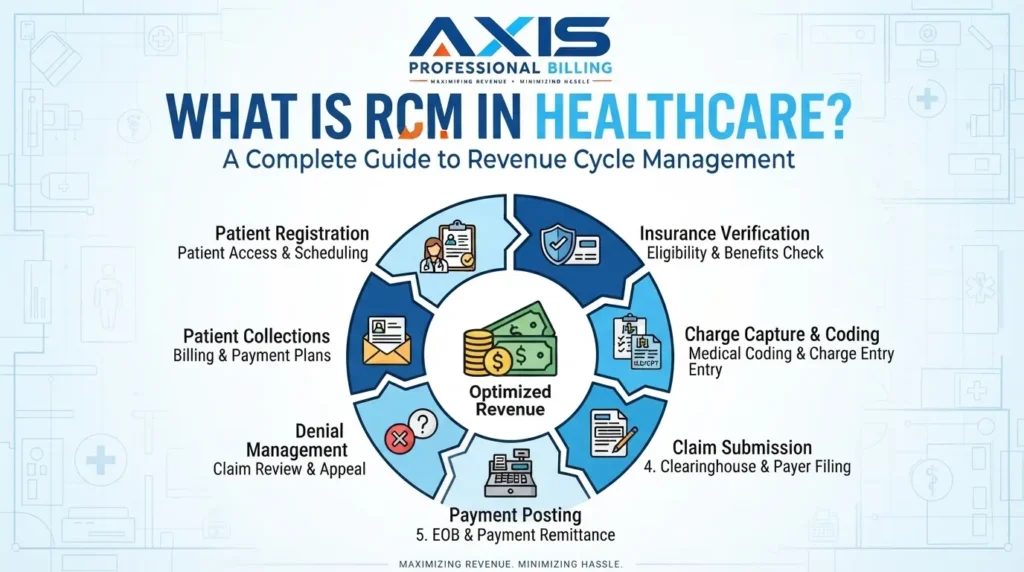
Medical billing is also the backbone of what the industry calls Revenue Cycle Management, or RCM: the entire financial journey of a patient encounter, from the moment an appointment is scheduled to the moment the account is closed out at a zero balance. Billing is one link in that chain, arguably the most consequential one, because it’s where clinical documentation either converts cleanly into revenue or gets stuck.
Medical Billing vs. Medical Coding: What’s the Difference?
This is probably the single most confused pair of terms in healthcare administration, so it’s worth settling clearly.
Medical coding is the process of translating a provider’s documentation, the diagnosis, the procedure, the supplies used, into standardized alphanumeric codes. Coders use systems like ICD-10-CM for diagnoses, CPT for procedures, and HCPCS for equipment and services. Coding answers the question: what exactly happened during this visit, expressed in a language payers can process?
Medical billing picks up where coding leaves off. It takes those codes, packages them into a claim, submits that claim to the correct payer, tracks its status, handles denials, and manages what the patient owes once insurance has paid its share.
Think of it this way: coding describes the encounter, billing gets you paid for it. In smaller practices, one person often wears both hats. In larger organizations, they’re usually separate roles working in close coordination, because an error in coding almost always shows up later as a billing denial. Our team’s dedicated medical coding services exist specifically because this handoff is where so many preventable errors originate.
Why Medical Billing Matters More Than Most Providers Realize
Every dollar a healthcare organization earns passes through the billing process at some point. That makes it one of the only functions in a practice that touches clinical care, compliance, and cash flow all at once.
A few reasons it deserves more attention than it typically gets:
- It directly controls cash flow. Slow or inaccurate billing means slower payments, and slower payments mean payroll, rent, and supply orders get harder to manage, regardless of how many patients walked through the door.
- It’s a compliance checkpoint, not just a financial one. Incorrect coding or billing, even when unintentional, can trigger payer audits, recoupments, or regulatory penalties.
- It shapes the patient experience. Confusing bills and surprise charges are one of the fastest ways to erode trust that took years of good clinical care to build.
- It’s where preventable revenue quietly disappears. Unlike a denied claim, which at least generates a paper trail, a service that’s never charged or coded correctly often vanishes without anyone noticing.
The Medical Billing Process, Step by Step
The billing cycle looks different depending on the size of the practice and the specialty, but the underlying sequence is remarkably consistent across the industry. Here’s how it actually unfolds.
1. Patient Registration and Insurance Verification
Before anything clinical happens, front-desk staff collect demographic details and insurance information, then verify that coverage is active and applies to the planned visit. This is the single most underrated step in the entire process. A huge share of denials that show up weeks later trace back to something that could have been caught right here, an expired policy, a plan that doesn’t cover a specific service, or a referral requirement nobody flagged. Thorough eligibility verification at this stage prevents far more revenue loss than any amount of cleanup work later in the cycle.
2. Prior Authorization (When Required)
Certain procedures, imaging studies, and medications need payer approval before they happen, not after. Skipping this step is one of the costliest mistakes in billing, because a missing authorization can void an entire claim regardless of how well it was coded. Building prior authorization checks into the scheduling workflow, rather than treating it as a billing afterthought, is what separates practices with low denial rates from those constantly fighting fires.
3. Charge Capture
Every billable service delivered during the visit, the exam, the labs, the procedure, the supplies used, needs to be recorded accurately. This is where a surprising amount of revenue quietly disappears. A service that never gets entered into the system is a service that never gets billed, and because there’s no denial or rejection attached to it, it rarely shows up on anyone’s radar until someone runs a deep audit.
4. Medical Coding
Clinical documentation is converted into standardized codes: ICD-10-CM for the diagnosis, CPT for the procedure, and HCPCS Level II for equipment or supplies not covered by CPT. Coding accuracy is the foundation everything downstream depends on. A code that doesn’t match the documentation, or a missing modifier that would have clarified the circumstances of the service, is one of the most common reasons a clean-looking claim still gets rejected.
5. Claim Creation and Scrubbing
Coded charges are compiled into a claim, typically formatted as a CMS-1500 for professional services or a UB-04 for institutional billing. Before it goes anywhere, the claim runs through a scrubbing process that checks for missing fields, formatting issues, and payer-specific rule violations. This is the last real checkpoint before submission, and a disciplined scrubbing process catches a meaningful share of denials before they ever happen.
6. Claims Submission
Clean claims are transmitted electronically, usually through a clearinghouse that adds another layer of validation and routes the claim to the correct payer. Electronic claim submission has become close to universal in the industry because it’s faster and dramatically less error-prone than paper filing.
7. Payer Adjudication
The insurer reviews the claim against the patient’s coverage, medical necessity rules, and the provider’s contract terms, then decides to pay it in full, deny it, or pay part of it with an adjustment. The result comes back as an Explanation of Benefits (EOB) or an Electronic Remittance Advice (ERA), spelling out what was paid, what was adjusted, and why.
8. Payment Posting
Payments and adjustments get recorded against the patient’s account. Precision matters here more than people assume, because a misposted payment quietly distorts your aging reports and can make a perfectly healthy account look delinquent, or hide a genuinely delinquent one.
9. Denial Management and Appeals
Denied or underpaid claims get reviewed, corrected where needed, and resubmitted or appealed. This is where a meaningful chunk of recoverable revenue either gets recovered through diligent follow-up, or quietly written off because nobody had the time to fight for it. Strong denial management is less about reacting to individual denials and more about building a system that catches patterns before they repeat.
10. Patient Billing and Collections
Whatever insurance doesn’t cover, copays, deductibles, coinsurance, gets billed to the patient. With deductibles trending higher across most plans, patient responsibility now makes up a growing share of total practice revenue, which is why clear, upfront billing communication matters almost as much as payer negotiations. Outstanding balances that stall out often need dedicated accounts receivable recovery to actually get collected rather than written off.
Who’s Involved in the Medical Billing Process?
Medical billing isn’t a solo act. It runs through several parties, each with a different role and a different incentive:
- Providers deliver the care and generate the clinical documentation everything else depends on.
- Payers, insurance companies, Medicare, Medicaid, are responsible for reimbursing claims according to a patient’s specific coverage terms.
- Patients are increasingly active financial participants, especially under high-deductible plans that shift more cost directly to them.
- Medical billers and coders, whether in-house or outsourced, translate clinical care into clean, compliant claims and manage the cycle from charge entry to final payment.
- Clearinghouses act as intermediaries, validating and routing electronic claims between providers and payers, catching formatting errors before they ever reach the payer.
Common Medical Billing Errors, and How to Actually Fix Them
Most denials aren’t exotic or unpredictable. They’re the same handful of preventable mistakes showing up again and again across practices of every size.
- Incorrect or missing patient information. A transposed digit in a policy number or an outdated address is enough to bounce a claim outright. Fix: verify demographics and insurance at every single visit, not just the first one.
- Coding mismatches. A code that doesn’t align with the documentation, or one that’s been replaced by a newer version. Fix: routine coder education paired with periodic chart audits.
- Missing or incorrect modifiers. Modifiers clarify circumstances, like a procedure performed on both sides of the body, and their absence is a frequent, entirely avoidable trigger for denial. Fix: build modifier checks directly into your scrubbing workflow.
- Duplicate billing. Usually happens when a claim gets resubmitted before the original has finished adjudicating. Fix: track claim status centrally so staff aren’t working off stale information.
- Missed timely filing deadlines. Every payer sets a submission window, and once it closes, that revenue is typically gone for good. Fix: automated aging alerts well before the deadline arrives, not after.
- Lack of prior authorization. One of the most expensive mistakes in billing, because the entire claim can be denied outright, regardless of how medically necessary the service was. Fix: authorization checks belong in scheduling, not billing.
None of these are complicated in isolation. What makes them expensive is volume. A 1 to 2 percent error rate across a few thousand monthly claims adds up to real, recurring revenue loss that compounds month after month if nobody addresses the root cause.
Denial Management: Where the Real Money Gets Recovered
Industry data consistently shows that somewhere around one in five medical claims gets denied on first submission, and the overwhelming majority of those denials trace back to preventable causes. That statistic alone is why denial management deserves its own strategy rather than being treated as an afterthought bolted onto the billing process.
A denial management framework that actually works usually includes:
- Categorizing denials by root cause, technical, clinical, or administrative, so patterns become visible instead of feeling random.
- Tracking denial rate by payer. Some insurers deny more aggressively, or on different grounds, than others, and knowing this shapes how you prioritize follow-up.
- Maintaining an appeal deadline calendar. Appeals have hard windows, and a missed deadline turns a recoverable denial into a permanent loss.
- Feeding denial data back into the front end. The strongest billing operations treat every denial as diagnostic information, one that should change something upstream, whether that’s a scheduling check, a documentation prompt, or a coding refresher.
Practices that build this feedback loop consistently see their denial rates trend downward over time instead of staying flat year after year.
In-House vs. Outsourced Medical Billing: The Real Comparison
This is usually the question sitting underneath the question. Most people researching medical billing aren’t just trying to understand the mechanics, they’re trying to decide who should actually run it for their practice.
In-House Billing
Advantages: direct oversight and immediate access to staff, tighter integration with clinical workflows, no revenue-share fee paid to an outside vendor.
Drawbacks: ongoing salary, benefits, and turnover costs for trained billing staff; continued investment in software, clearinghouse fees, and compliance training; vulnerability to staffing gaps, since one biller calling in sick can stall an entire claims queue; and difficulty keeping pace with constantly shifting payer rules across multiple insurers.
Outsourced Billing
Advantages: access to specialized expertise across coding updates, payer rules, and denial trends; the ability to scale up or down without a hiring or layoff cycle; built-in analytics and reporting in most partnerships; and reduced exposure to single points of failure, since one person’s absence doesn’t stall the entire operation.
Drawbacks: an ongoing fee, typically a percentage of collections; somewhat less day-to-day visibility unless the partner provides strong, transparent reporting; and the need for real due diligence to confirm the partner’s compliance practices and data security standards.
Cost Comparison at a Glance
In-house billing costs are largely fixed. Salaries, benefits, software licenses, and clearinghouse fees add up regardless of claim volume, which means a slow month still carries the full weight of overhead. Outsourced billing, on the other hand, is typically structured as a percentage of collections, which means cost scales directly with revenue, lighter during slower periods, though it can feel expensive during high-volume months.
The right answer depends heavily on claim volume, specialty complexity, and how much bandwidth your team genuinely has to stay current on payer rule changes. Smaller practices, and specialties dealing with frequently updated coding rules, often find that partnering with a team built specifically for end-to-end billing and revenue cycle management closes gaps that would otherwise take years to build internally. If you’re trying to figure out where your practice fits, our pricing structure is a reasonable place to start comparing real numbers rather than guessing.
Compliance and HIPAA: The Non-Negotiables
Medical billing sits at the intersection of two heavily regulated worlds, healthcare data and financial transactions, which means compliance isn’t optional overhead. It’s core to how the function has to operate every single day.
Key compliance considerations include:
- HIPAA Privacy and Security Rules, which govern how patient health and billing information is stored, transmitted, and accessed.
- Documentation-supported coding, since upcoding or unsupported coding, even when unintentional, can trigger audits and financial penalties.
- Business Associate Agreements (BAAs) with any outsourced billing partner or software vendor that touches protected health information.
- Regular audits, both internal and third-party, to catch compliance drift before a payer or regulator does it for you.
Our security and compliance practices are built around exactly these requirements, because a billing partner that treats compliance as an afterthought is a liability, not a service. For authoritative, current guidance on billing regulations and coverage policy, the Centers for Medicare & Medicaid Services remains the primary source practices should monitor directly.
How Technology and AI Are Changing Medical Billing
Billing has always been rules-based and repetitive work, which happens to be exactly the kind of task modern automation handles well. A meaningful share of claim denials are preventable at the point of data entry, and that’s precisely where AI-assisted tools are having the most impact right now.
The applications gaining the most traction include:
- Real-time eligibility verification checked at scheduling and check-in, instead of a single verification done weeks or months earlier.
- AI-assisted coding suggestions drawn directly from clinical documentation, which coders then review and finalize rather than accept blindly.
- Predictive denial scoring that flags claims likely to be rejected before they’re ever submitted.
- Automated appeal drafting that pulls relevant clinical details together to speed up response time.
- AR prioritization, ranking outstanding claims by dollar value and payer behavior so staff spend their time on the highest-impact accounts first.
It’s worth being honest about what this technology actually does. The realistic model isn’t full automation, it’s AI-assisted human billing, where software absorbs the repetitive triage work and experienced staff focus on judgment calls, payer disputes, and genuine exceptions. Our analytics and reporting tools are designed around this exact philosophy: give practices visibility into their financial performance without pretending a dashboard can replace an experienced biller’s judgment.
Specialty-Specific Billing Nuances
Generic billing knowledge only goes so far once you’re dealing with specialty-specific payer rules, and this is where a lot of practices get tripped up without realizing it.
- Mental health billing often involves time-based coding, prior authorization requirements, and parity law considerations that simply don’t exist in other specialties. Our team supports mental health billing with this complexity built into the workflow from day one.
- Physical therapy frequently requires unit-based billing, therapy caps, and functional reporting that generic billing teams often miss. See how we handle physical therapy billing specifically.
- Pain management involves frequent prior authorizations and tightly regulated documentation around controlled substances. Our pain management billing approach is built around exactly these requirements.
- Surgical practices deal with bundled coding, global periods, and modifier accuracy for staged or related procedures, all covered under our surgery billing services.
- OB-GYN practices navigate global maternity billing packages alongside separately billable services, a nuance we address directly through our OB-GYN billing team.
- DME providers face equipment-specific coding and documentation requirements that differ substantially from standard professional billing, handled through our dedicated DME billing services.
- Hospitals and health systems deal with a scale and complexity that demands dedicated infrastructure, which is why our hospital and health system billing support is structured differently from small-practice billing.
Practices in specialty-heavy fields consistently benefit from billing support built around their exact documentation and payer patterns, rather than a one-size-fits-all approach applied across every specialty equally.
Provider Credentialing: The Step Before Billing Even Starts
Here’s something a lot of billing guides skip entirely: none of the process above works if a provider isn’t properly credentialed with a payer in the first place. Credentialing verifies a provider’s qualifications and gets them approved to bill a specific insurance network, and it can take anywhere from 60 to 120 days depending on the payer. Practices that overlook this timeline often find themselves sitting on completed, accurate claims with nowhere to send them. Getting credentialing handled early, and kept current, prevents a bottleneck that has nothing to do with coding or claims accuracy and everything to do with timing.
Medical Billing Best Practices Checklist
- Verify insurance eligibility and benefits at every visit, not just the first one.
- Confirm prior authorization requirements before the appointment, not after.
- Capture all billable charges at the point of care, every time.
- Run every claim through scrubbing software before it’s submitted.
- Track denials by category and payer to spot patterns early.
- Set internal deadlines well ahead of payer timely-filing windows.
- Post payments and adjustments promptly and accurately.
- Audit coding accuracy on a regular schedule, not only when problems appear.
- Give patients clear, upfront estimates of their financial responsibility.
- Review your aging report weekly instead of monthly.
Practices that treat this as a routine operating rhythm, rather than a fire drill triggered by cash flow problems, consistently outperform the ones that only pay attention to billing when something goes wrong.
How to Choose the Right Medical Billing Partner
If you’ve read this far, you’ve probably already sensed that billing isn’t a task you delegate and forget about, it’s a relationship that needs oversight either way, whether the work happens down the hall or with an outside partner. A few questions worth asking before you commit to either path:
- Does the team or partner have real experience in your specific specialty, or are they applying generic billing knowledge across the board?
- How transparent is their reporting? You should be able to see denial rates, AR aging, and collection performance without having to ask for it.
- What’s their track record on first-pass claim acceptance and average days in AR?
- Are their compliance and data security practices documented, auditable, and current, not just claimed?
- Do they treat denials as a feedback loop that improves the process, or as isolated incidents to be resubmitted and forgotten?
If you’d like a clearer picture of how a dedicated billing partner actually operates day to day, our team page and the practices we work with are good starting points, and reaching out through our contact page costs nothing but a few minutes of your time.
Frequently Asked Questions
What is medical billing in simple terms? Medical billing is the process of submitting and following up on claims with health insurance companies, or billing patients directly, to receive payment for healthcare services a provider has already performed.
What’s the difference between medical billing and medical coding? Coding translates a clinical encounter into standardized diagnostic and procedural codes. Billing takes those codes and manages the process of submitting claims, tracking payments, and resolving denials until the balance is settled.
How long does the medical billing process take? A clean claim is often paid within two to four weeks. Denials, appeals, or complex payer review can stretch that timeline out to several months.
What are the most common reasons claims get denied? Missing or inaccurate patient information, coding errors, missing modifiers, lack of prior authorization, and missed filing deadlines account for the large majority of denials across every specialty.
Is it cheaper to outsource medical billing? It depends on claim volume and complexity. Outsourcing typically costs a percentage of collections, while in-house billing carries fixed salary and software costs regardless of volume. Outsourcing often becomes more cost-effective for smaller practices or those without dedicated billing expertise already on staff.
Do I need a certified coder for medical billing? Certified coders aren’t legally required in every setting, but their expertise measurably reduces coding errors and denial rates, which usually pays for itself through fewer lost claims over time.
How does AI change medical billing? AI tools assist with eligibility checks, coding suggestions, and denial prediction, cutting down on manual triage work. Experienced billing staff remain essential for judgment calls, payer disputes, and appeals that software genuinely can’t handle on its own.
What percentage of medical claims get denied? Industry estimates commonly cite an initial denial rate of roughly 10 to 12 percent across the U.S. healthcare system, though this varies significantly by specialty, payer mix, and how disciplined a practice’s front-end verification process is.
The Bottom Line
Medical billing isn’t an administrative afterthought tucked behind the clinical side of a practice, it’s the mechanism that determines whether the care you deliver actually turns into the revenue that keeps your doors open. The organizations that treat billing as a strategic function, with clear processes, consistent denial tracking, and the right mix of technology and human judgment, are the ones that see steadier cash flow and fewer surprises when they pull their aging report.
Whether that means tightening up your in-house team, bringing in outside expertise, or blending both approaches, the goal stays the same: fewer denials, faster payment, and a financial process that supports the care you’re already providing instead of quietly working against it.
If you’re trying to figure out whether your current billing setup is actually performing the way it should, a conversation costs nothing. Get in touch with our team and we’ll walk through exactly where your revenue cycle stands.